

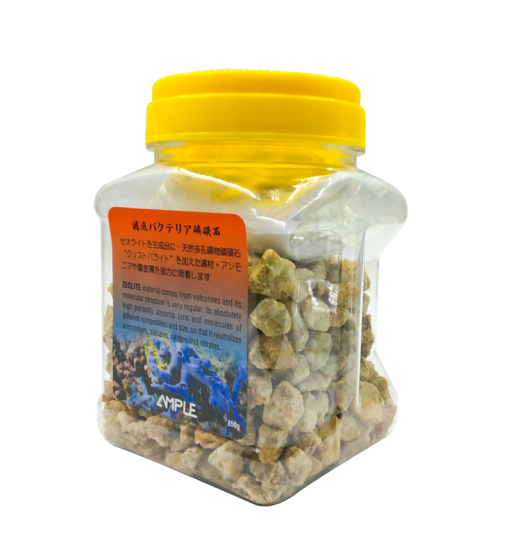
Zeolite is a natural crystallized mineral of volcanic rock, that acts as an aquarium filter media by using ion exchange to absorb and remove ammonia and heavy metals from freshwater tanks. It is particularly useful for quickly reducing dangerous ammonia spikes from fish waste and uneaten food, but it is not a permanent solution as it becomes saturated and must be replaced.
Zeolite, also known as sodium aluminum silicate, has a complex, porous structure with a large surface area. It binds ammonia and ammonium ions from the water, releasing sodium ions in exchange. This ion exchange process effectively removes toxic ammonia, which is harmful to fish and other aquatic life. It can also absorb other undesirable substances and heavy metals.
The most popular application of zeolites - is the absorption of toxins, heavy metals, molds and bad odors. The honeycomb structure of the zeolite rock allows the hard substance to absorb a large number of molecules of gas, moisture and many chemicals. The natural mineral has also proven its efficacy against heavy metals and other substances such as: radioactive gases, bacterial odors, formaldehyde, sulfur dioxide, mercury, lead, ammonia, chlorine and nitrogen molecules etc. Zeolite can bind the above substances, thereby normalizing the biological composition of the water. Due to Zeolite, the water pH of is stabilizing, phenols and heavy metals are bound. Reduction of ammonia prevents algae excessive growth.
Usage: Zeolite is best used to address sudden increases in ammonia, such as during a new aquarium cycle or when there's a high bioload. Clinoptilolite zeolites are adapted for use in various filters as top filter, external filter, hang-on-back filters and submersible filter pump, or just to spread onto bottom substrate. By actively absorbing ammonia it improves the biological balance in the aquarium. High concentrations of ammonium contamination are considered to be a concentration of 1 milligram per liter. 1 kilogram of natural zeolite is enough to absorb 3-5 grams of ammonium. The optimal dose is the use of 1 kilogram of natural zeolite per 1 cubic meter of water or 1 gram per 1 liter.
Zeolite is not recommended as a regular, long-term filtration media because it becomes saturated and ineffectual once its binding sites are filled.

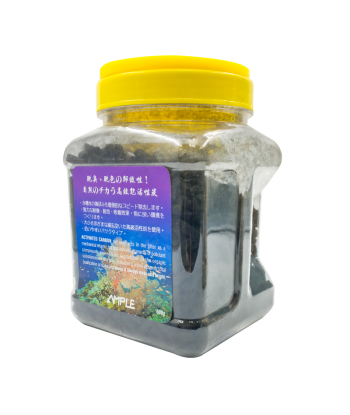
Activated carbon aquarium filter media improves water quality by chemically adsorbing dissolved pollutant compounds derived from degeneration of the organic substances. In this way, Activated Carbon clarifies cloudy water, removes odors, and eliminates tannins that cause yellowing. It also removes medications, chlorine, chloramines, and certain phenols but does not address ammonia, nitrite, or nitrate.
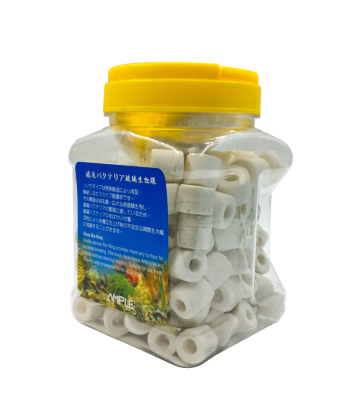
Sintered glass bio-rings are high-porosity filter media that provide an exceptionally large surface area for beneficial bacteria to colonize, leading to highly efficient biological filtration and improved water quality in aquariums and ponds. Made from high-quality minerals, they establish a stable environment for nitrifying bacteria that rapidly process ammonia and nitrites, reduce algae by breaking down organic matter, and remain neutral in pH without altering water parameters.
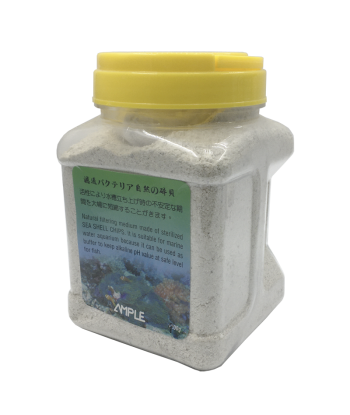
Oyster shell chips (in fine grind it is shell powder) serves as natural water conditioner, as well as natural filter media. The main effects of Oyster shell chips in saltwater aquarium are: 1) Acting as a buffer to help stabilize pH and Alkalinity, 2) Supplement calcium, carbonate minerals and trace elements, 3) Provide biological filtration surface.
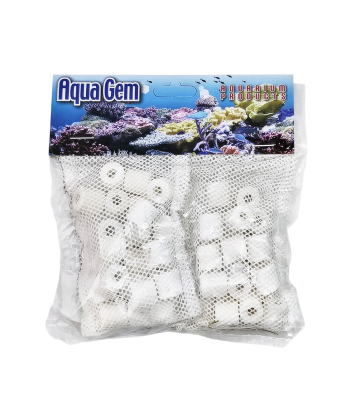
Sintered glass bio-rings are high-porosity filter media that provide an exceptionally large surface area for beneficial bacteria to colonize, leading to highly efficient biological filtration and improved water quality in aquariums and ponds. Made from high-quality minerals, they establish a stable environment for nitrifying bacteria that rapidly process ammonia and nitrites, reduce algae by breaking down organic matter, and remain neutral in pH without altering water parameters.
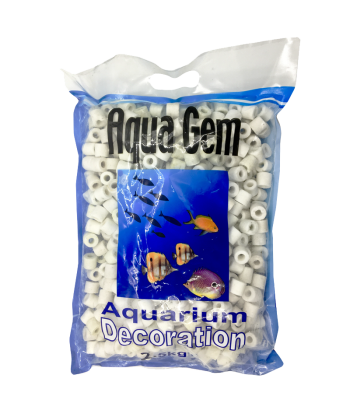
Sintered glass bio-rings are high-porosity filter media that provide an exceptionally large surface area for beneficial bacteria to colonize, leading to highly efficient biological filtration and improved water quality in aquariums and ponds. Made from high-quality minerals, they establish a stable environment for nitrifying bacteria that rapidly process ammonia and nitrites, reduce algae by breaking down organic matter, and remain neutral in pH without altering water parameters.

Zeolite is a natural crystallized mineral of volcanic rock, that acts as an aquarium filter media by using ion exchange to absorb and remove ammonia and heavy metals from freshwater tanks. It is particularly useful for quickly reducing dangerous ammonia spikes from fish waste and uneaten food, but it is not a permanent solution as it becomes saturated and must be replaced.
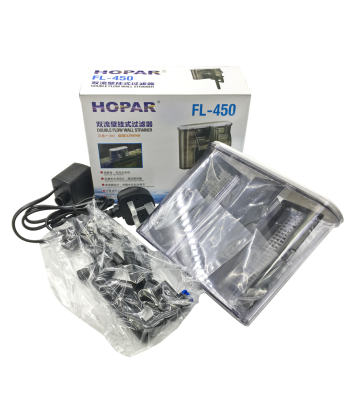
The waterfall filter is also known as a hanging filter. Slim hanging filter is a compact filtration system designed to be mounted from one of the panes of glass of an aquarium, efficiently filtering water without occupying internal tank space. The primary function of this filter is to maintain water quality by removing debris, toxins, and harmful substances, contributing to a healthy aquatic environment.
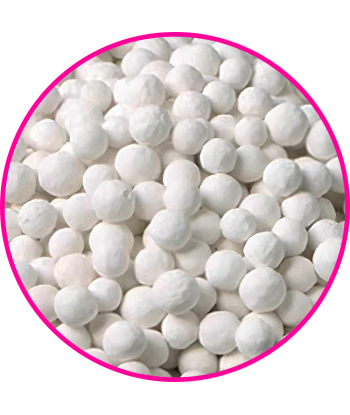
Quartz Bio-Beads not only have a large effective surface area (8-20 times that of other filter materials) and an extremely permeable structure, but also contain a variety of elements such as calcium oxide, sodium, potassium, magnesium, etc., which is an ideal environment for nitrifying bacteria (aerobic and anaerobic). Therefore, it can cultivate extra multitude units of beneficial bacteria.

Bio-sponge pad is a porous, cut-to-fit foam sheet that provides mechanical filtration by trapping debris and biological filtration by cultivating beneficial bacteria to break down waste. These pads are versatile, can be customized for various filter types, and help maintain a healthy and clear aquarium environment by supporting the nitrogen cycle. Its multi-porous feature will avoid blockages and provide the largest adhesion area for beneficial nitro bacteria. These bacteria break down toxic fish waste (ammonia and nitrite) into less harmful compounds, creating a healthy, stable environment for aquatic life and clarifying the water.
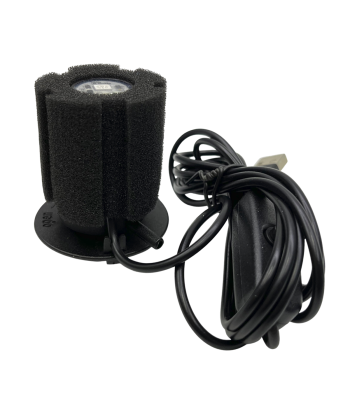
This pneumatic filter is designed for application with mini tank. The high grade filter media provides efficient biological filtration and filter is easy to install with air pump.

Expanded Clay Pebbles, universally known as LECA (Lightweight Expanded Clay Aggregate), are a staple in advanced growing techniques like hydroponics, aquaponics, and for improving soil. While expanded clay pebbles are not a direct "algae remover" like a chemical treatment or an algae-eating creature, they work by creating conditions that are unfavorable for algae growth.
Zeolite is a natural crystallized mineral of volcanic rock, that acts as an aquarium filter media by using ion exchange to absorb and remove ammonia and heavy metals from freshwater tanks. It is particularly useful for quickly reducing dangerous ammonia spikes from fish waste and uneaten food, but it is not a permanent solution as it becomes saturated and must be replaced.
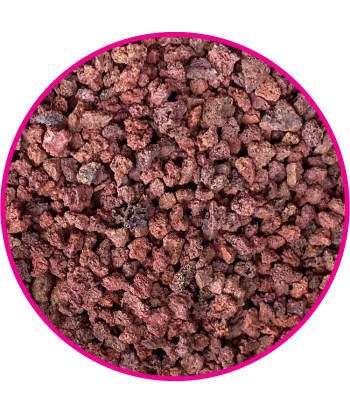
The rough, highly porous surface structure of biofiltration volcanic rock provides very good colonization conditions for purified bacteria. Since it is a natural product, the size of the granules and small pieces in the packaging is different for each piece. It can be washed and reused. It is suitable for both freshwater and seawater.
Sintered glass bio-rings are high-porosity filter media that provide an exceptionally large surface area for beneficial bacteria to colonize, leading to highly efficient biological filtration and improved water quality in aquariums and ponds. Made from high-quality minerals, they establish a stable environment for nitrifying bacteria that rapidly process ammonia and nitrites, reduce algae by breaking down organic matter, and remain neutral in pH without altering water parameters.

Bio-sponge pad is a porous, cut-to-fit foam sheet that provides mechanical filtration by trapping debris and biological filtration by cultivating beneficial bacteria to break down waste. These pads are versatile, can be customized for various filter types, and help maintain a healthy and clear aquarium environment by supporting the nitrogen cycle. Its multi-porous feature will avoid blockages and provide the largest adhesion area for beneficial nitro bacteria. These bacteria break down toxic fish waste (ammonia and nitrite) into less harmful compounds, creating a healthy, stable environment for aquatic life and clarifying the water.

Hollow mineral beads are filter materials specially designed for aquariums. They have a variety of characteristics and effectively solve water quality problems. The hollow structure can form a special low oxygen environment, which is conducive to the reproduction of a large number of nitrifying bacteria, rapid bacterial cultivation and purifying water quality.
Sintered glass bio-rings are high-porosity filter media that provide an exceptionally large surface area for beneficial bacteria to colonize, leading to highly efficient biological filtration and improved water quality in aquariums and ponds. Made from high-quality minerals, they establish a stable environment for nitrifying bacteria that rapidly process ammonia and nitrites, reduce algae by breaking down organic matter, and remain neutral in pH without altering water parameters.

Activated carbon aquarium filter media improves water quality by chemically adsorbing dissolved pollutant compounds derived from degeneration of the organic substances. In this way, Activated Carbon clarifies cloudy water, removes odors, and eliminates tannins that cause yellowing. It also removes medications, chlorine, chloramines, and certain phenols but does not address ammonia, nitrite, or nitrate.
Oyster shell chips (in fine grind it is shell powder) serves as natural water conditioner, as well as natural filter media. The main effects of Oyster shell chips in saltwater aquarium are: 1) Acting as a buffer to help stabilize pH and Alkalinity, 2) Supplement calcium, carbonate minerals and trace elements, 3) Provide biological filtration surface.
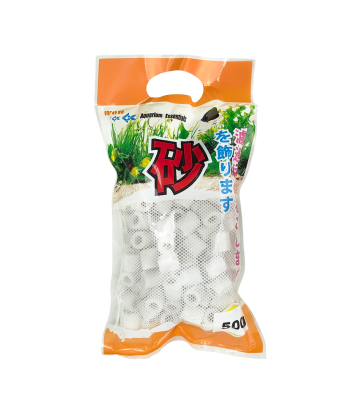
Sintered glass bio-rings are high-porosity filter media that provide an exceptionally large surface area for beneficial bacteria to colonize, leading to highly efficient biological filtration and improved water quality in aquariums and ponds. Made from high-quality minerals, they establish a stable environment for nitrifying bacteria that rapidly process ammonia and nitrites, reduce algae by breaking down organic matter, and remain neutral in pH without altering water parameters.
Sintered glass bio-rings are high-porosity filter media that provide an exceptionally large surface area for beneficial bacteria to colonize, leading to highly efficient biological filtration and improved water quality in aquariums and ponds. Made from high-quality minerals, they establish a stable environment for nitrifying bacteria that rapidly process ammonia and nitrites, reduce algae by breaking down organic matter, and remain neutral in pH without altering water parameters.
Activated carbon aquarium filter media improves water quality by chemically adsorbing dissolved pollutant compounds derived from degeneration of the organic substances. In this way, Activated Carbon clarifies cloudy water, removes odors, and eliminates tannins that cause yellowing. It also removes medications, chlorine, chloramines, and certain phenols but does not address ammonia, nitrite, or nitrate.
Zeolite is a natural crystallized mineral of volcanic rock, that acts as an aquarium filter media by using ion exchange to absorb and remove ammonia and heavy metals from freshwater tanks. It is particularly useful for quickly reducing dangerous ammonia spikes from fish waste and uneaten food, but it is not a permanent solution as it becomes saturated and must be replaced.